
The American Old West refers to the western United States during the era of westward expansion, from the major expeditions of the early 19th century to the closing of the frontier around 1890. In the narrower sense associated with Westerns and cowboys, it usually means the years from 1860 to 1890: the territories west of the Mississippi, stretching from the Great Plains to the Pacific.
Behind the phrase that instantly brings to mind a saloon, a hat, and a horse is a history far more specific—and far harsher—than the one we see in movies. Here are the dates that matter, the places, the real people, and what this era left behind in the way we dress.
Where the term “Far West” comes from
“Far West” is an English expression that literally means “the distant West.” For Americans in the late 18th century, the West began just beyond the Appalachian Mountains: Ohio and Kentucky were frontier lands at the time. As settlers moved farther west, the term shifted to increasingly distant regions until, in the 19th century, it came to mean everything beyond the Mississippi.
In French, the expression was simply borrowed as is. It can be written “Far West,” “far-west,” or, less often, “farwest” as one word. The hybrid phrase “far ouest” exists in speech and in a few titles, but it never replaced the original. By extension, people say “it’s the Wild West” to describe a place or industry where everyone makes their own rules.
Americans today are more likely to use two other expressions. Old West or American Old West refers to the historical era. Wild West emphasizes violence and legend: the phrase owes much to Buffalo Bill’s touring show, launched in 1883 as Buffalo Bill's Wild West. In short, the Far West is first and foremost a place; the Wild West is mainly an image.
Key dates in westward expansion
There’s no official start or end date. American historians place the western frontier in a period spanning 1803 to 1912, but the cowboy era—the one most people picture—centers on about 30 years after the Civil War (1861–1865). This table covers the key milestones.
| Date | Event | What changed |
|---|---|---|
| 1803 | The Louisiana Purchase from Napoleon’s France for $15 million | The size of the United States doubles overnight, reaching the Rocky Mountains |
| May 1804–September 1806 | Meriwether Lewis and William Clark expedition | First documented overland route to the Pacific, reached in November 1805 |
| 1843–1860s | Oregon Trail: the “Great Migration” of 1843 (700 to 1,000 people), followed by peak traffic from 1846 to 1869 | About 400,000 emigrants travel roughly 2,175 miles by wagon |
| 1845 | Journalist John L. O’Sullivan uses the term “Manifest Destiny” | Westward expansion becomes a political doctrine |
| January 24, 1848 | James Marshall discovers gold at Sutter’s Mill near Coloma, California | Gold Rush: about 300,000 arrivals, including the “Forty-Niners” of 1849 |
| May 20, 1862 | Abraham Lincoln signs the Homestead Act | 160 acres offered to anyone who farms the land for five years |
| 1866–1867 | First major cattle drives from Texas; Abilene, Kansas, becomes a railhead in 1867 | The Chisholm Trail and the golden age of the cowboy begin |
| May 10, 1869 | The railroad tracks meet at Promontory Summit in Utah Territory | First transcontinental railroad, linking the East Coast to California |
| June 25–26, 1876 | Battle of the Little Bighorn in Montana Territory | Custer is defeated by Lakota, Cheyenne, and Arapaho forces |
| October 26, 1881 | Gunfight at the O.K. Corral in Tombstone, Arizona Territory | Thirty seconds of gunfire that would become a legend |
| 1883 | Buffalo Bill’s first “Wild West” show | The Old West becomes a show before it has even ended |
| Winter 1886–1887 | Disastrous winter on the Northern Plains | Hundreds of thousands of cattle die, and open-range ranching collapses |
| December 29, 1890 | Wounded Knee Massacre in South Dakota | End of the Indian Wars on the Plains |
| 1890–1893 | The 1890 census finds no longer any frontier line; on July 12, 1893, Frederick Jackson Turner presents his “frontier thesis” | The end of the Old West becomes an accepted fact |
| 1912 | New Mexico (January 6) and Arizona (February 14) become states | The 48 contiguous states are complete |
From the Louisiana Purchase to the Gold Rush
In 1803, Thomas Jefferson bought the vast Louisiana Territory from France. It was nothing like the present-day state of Louisiana: it covered the entire Missouri River basin. He immediately sent Lewis and Clark to explore it. They set out on May 14, 1804, reached the Pacific in November 1805, and returned to St. Louis on September 23, 1806.
In the 1840s, the first wagon trains left Independence, Missouri, bound for Oregon. In 1845, John L. O’Sullivan wrote in the Democratic Review that it was the “manifest destiny” of Americans to expand across the continent. Three years later, the discovery of gold at Sutter’s Mill sparked the California Gold Rush, drawing about 300,000 people between 1848 and 1855.
The railroad, cattle, and the end of the frontier
Everything accelerated after the Civil War. The Homestead Act of 1862 drew entire families to the Plains, the railroad connected the two oceans in 1869, and Texas ranchers realized that cattle worth a few dollars in Texas could fetch much more in the East. In 1867, entrepreneur Joseph McCoy built stockyards in Abilene, along the Kansas Pacific line: this marked the beginning of the great cattle drives.
Historians point to two milestones when discussing the end of the Old West. The first is symbolic: in 1890, the Census Bureau announced that settlement in the West was so scattered that a frontier line could no longer be drawn. The second is administrative: by 1912, with Arizona and New Mexico becoming states, no continental territory remained outside statehood.
States and towns of the Old West
The Old West was never an official region with defined borders. It refers to the territories conquered west of the Mississippi during the 19th century, which today make up about 20 states. The most iconic areas fall into three broad regions.
- The Great Plains: Texas, Oklahoma (then “Indian Territory”), Kansas, Nebraska, North Dakota, and South Dakota. This was cattle country, trail country, and bison country.
- The Rocky Mountains and deserts: Montana, Wyoming, Colorado, Utah, Nevada, Idaho, Arizona, and New Mexico. Gold and silver mines, ranches, and reservations.
- The Pacific Coast: California, Oregon, and Washington. The final destination of the pioneer trails.
Every Old West town had its own purpose. Cattle towns like Abilene, followed by Wichita and Dodge City in Kansas, depended on arriving herds and loading cattle onto trains. Mining towns like Tombstone, Arizona, and Deadwood, Dakota Territory, sprang up around a vein in a matter of months and sometimes emptied just as quickly. If you’d like to visit these places today, our Western road trip across the United States lays out the route and what to wear at each stop.
What cowboy life was really like
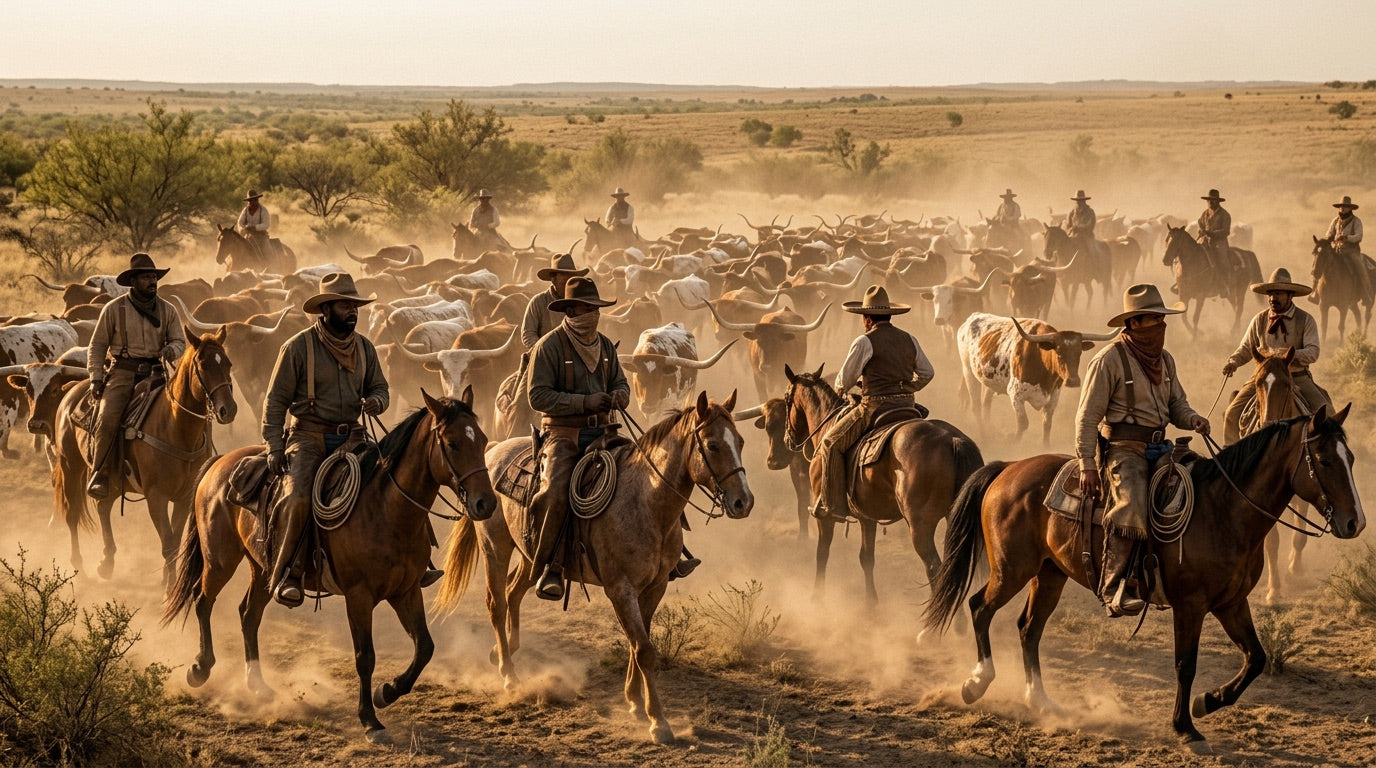
The cowboy is a direct descendant of the vaquero, the cattle herder of northern Mexico. The English word cowboy is itself a translation of vaquero (from vaca, meaning “cow”). English-speaking ranchers who arrived in Texas learned the trade from vaqueros and borrowed much of their vocabulary from them.
- Lasso comes from lazo, and lariat from la reata, a braided leather rope.
- Chaps is short for chaparreras, the leather leggings that protected riders from brush.
- Bronco means “rough, wild” in Spanish, hence an unbroken horse; mustang comes from mesteño, meaning an ownerless horse.
- Rodeo first referred to gathering cattle (from rodear, “to surround”) before becoming a sport.
- Buckaroo is an anglicized version of vaquero.
Who the cowboys really were
Cowboys in Westerns are almost all white. The reality was more diverse. According to estimates cited by the Library of Congress, including those of historian Kenneth Porter, of the roughly 35,000 cowboys who worked during the great cattle-drive era, 6,000 to 9,000 were Black. In Texas, as many as one in four cowboys was African American, often formerly enslaved. Mexican vaqueros and cowboys of Mexican descent also made up a significant part of the crews, especially in the Southwest.
A tough, low-paid job
A cowboy often started working at 12 or 13 and earned about $1 a day, with food and lodging when he was at the ranch. On the trail, a crew of about 10 men moved an average of 3,000 head of cattle. The cattle traveled about 15 miles a day to avoid losing weight, so the roughly 1,000-mile Chisholm Trail could take up to two months.
The days were long, the nights short (the herd had to be guarded in shifts), and the dangers very real: thunderstorms, flooded rivers, and stampedes. The golden age didn’t last long. Barbed wire, which spread in the 1880s, closed off the open ranges, and the winter of 1886–1887 killed hundreds of thousands of cattle across the Northern Plains. By the 1890s, railroads reached the ranches, and long drives to Kansas were no longer necessary.
Indigenous peoples and the disappearance of the bison
The Old West was not an empty land. Lakota, Cheyenne, Comanche, Apache, Arapaho, Navajo, and dozens of other nations lived there. The Indian Removal Act of 1830 had already forced many peoples from the East to lands west of the Mississippi. As settlers pushed farther west, treaties were made and broken, and the Indian Wars continued through much of the century.
The Battle of the Little Bighorn, on June 25–26, 1876, was the Plains peoples’ most famous victory: Lakota, Cheyenne, and Arapaho warriors, inspired by Sitting Bull and led in part by Crazy Horse, wiped out part of Lieutenant Colonel George Armstrong Custer’s 7th Cavalry. The U.S. Army suffered 268 deaths. Fourteen years later, on December 29, 1890, that same 7th Cavalry killed between 150 and 300 Lakota—including many women and children—at Wounded Knee on the Pine Ridge Reservation.
The disappearance of the bison was as consequential as the fighting. Estimates vary widely, but there were tens of millions of bison in North America before the 19th century (as many as 60 million, according to some estimates). Commercial hide hunting exploded in 1872–1873: that winter, more than 1.5 million bison were shipped east by rail. By the late 1880s, only about a thousand remained, according to naturalist William Hornaday. Deprived of their main resource, the peoples of the Plains were left with no choice but to move to reservations.
Outlaws, sheriffs, and a showman turned into legends
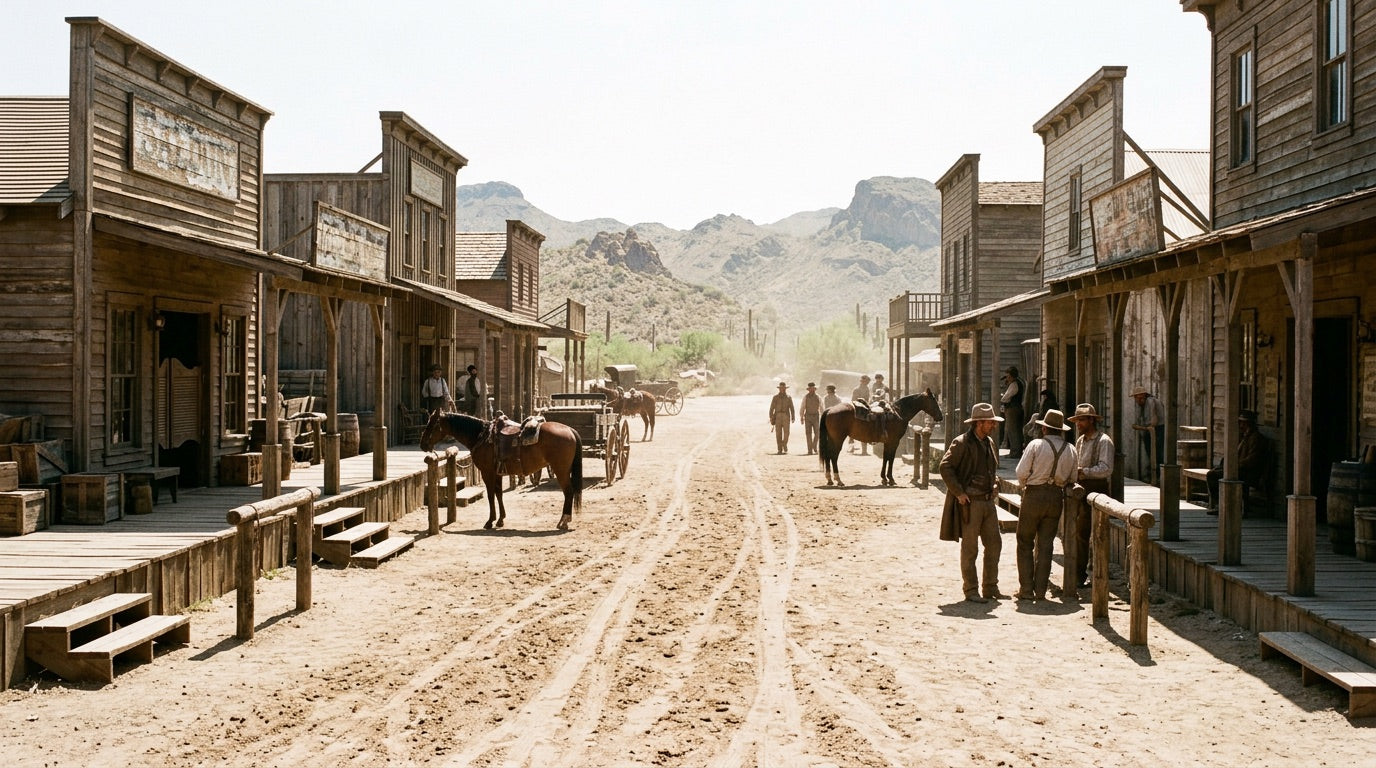
The Old West created its own heroes early on, often embellished during their lifetimes by the press and dime novels, which appeared as early as 1859. Their real lives were often short and far less glorious than their legends.
- Billy the Kid (Henry McCarty, aka William H. Bonney): shot by Sheriff Pat Garrett on July 14, 1881, in Fort Sumner, New Mexico.
- Jesse James (1847–1882): former Confederate soldier turned bank and train robber, shot in the head by gang member Robert Ford on April 3, 1882, in St. Joseph, Missouri.
- Wyatt Earp (1848–1929): lawman who faced the Clanton and McLaury brothers in Tombstone alongside his brothers Virgil and Morgan and his friend Doc Holliday. He died in Los Angeles in 1929, after spending time with Western actors in the hope they would tell his story.
- Calamity Jane (Martha Jane Canary, 1852–1903): settled in Deadwood in 1876, helped build her own legend, and began performing as a storyteller in Buffalo Bill’s show in 1893.
- Buffalo Bill (William F. Cody, 1846–1917): scout and bison hunter who created Buffalo Bill's Wild West in 1883, featuring battle reenactments, sharpshooters such as Annie Oakley, and real Plains warriors. The show toured Europe eight times and set up in Paris during the 1889 World’s Fair.
The gunfight at the O.K. Corral neatly captures the gap between fact and myth. On October 26, 1881, it didn’t actually take place in the corral, but on a narrow lot nearby, off Fremont Street. About 30 shots in 30 seconds, three dead (Billy Clanton, Tom McLaury, and Frank McLaury)—and dozens of movies made about it afterward.
Myth and reality in the Wild West
The Old West in Westerns is a highly compressed version of history. Face-to-face gunfights in the street were rare, and towns like Dodge City and Tombstone banned carrying guns within their limits (Ike Clanton was arrested shortly before the O.K. Corral gunfight for breaking that rule). Most pioneers were farming families, not gunslingers. The lone white cowboy erased vaqueros, Black cowboys, and the women who ran ranches.
By contrast, violence against Indigenous peoples was long minimized or presented backwards. The myth took shape while history was still unfolding: Buffalo Bill was staging the Old West by 1883, seven years before Wounded Knee, and popular novels turned outlaws into living Robin Hoods.
The Old West on screen
Movies inherited this myth from their earliest days. Edwin S. Porter’s The Great Train Robbery, released in 1903, already told the story of a train robbery in 12 minutes. John Ford made John Wayne a star with Stagecoach in 1939, and Sergio Leone reinvented the genre in Italy with Once Upon a Time in the West in 1968. Today, TV series are keeping the spirit alive, and their actors are bringing Western style back into fashion. We cover that in our article on celebrities and Western style, from Yellowstone to TikTok.
How the Old West shaped Western fashion
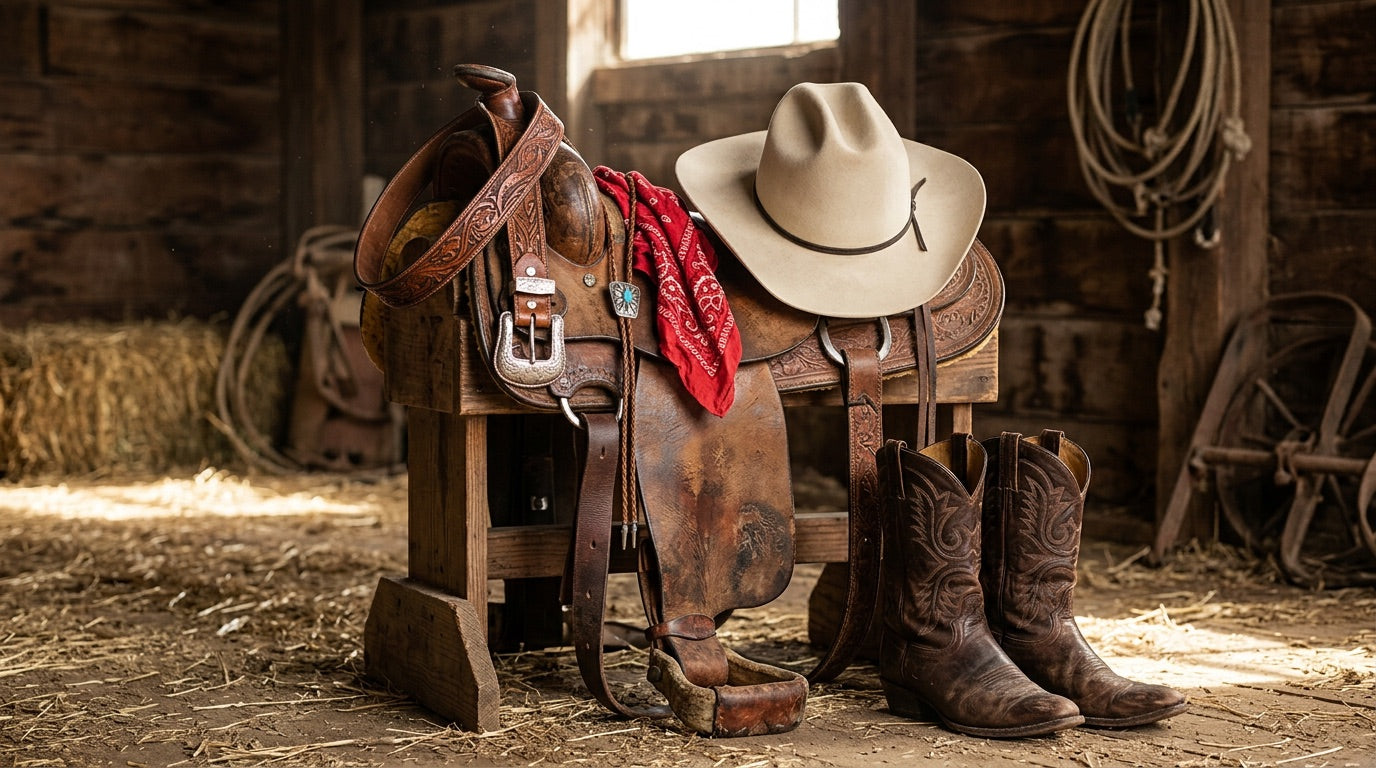
Almost every piece of the Western wardrobe began as a practical solution to life in the 19th-century West. The style came later, with rodeos, movies, and country singers. To follow this evolution from trail to runway, read our history of cowboy fashion, from ranch to runway.
The hat: from the “Boss of the Plains” to the Stetson
In 1865, John B. Stetson returned from a trip to the West, founded his company in Philadelphia, and made the “Boss of the Plains”: a lightweight, waterproof felt hat with a straight crown with rounded corners and a wide, flat brim, designed to protect the wearer from sun and rain. It’s the ancestor of every cowboy hat, whose crown was later creased and whose brim was turned up at the sides.
Boots: a heel designed for the stirrup
Cowboy boots have a tall shaft to protect the calf from chafing and brush, a narrow toe to slip into the stirrup, and a heel to keep the foot from sliding through. You’ll find the same design cues in our Western boots, with more detailed leatherwork and stitching than a work boot.
Belts, vests, bandanas, and bolo ties
The rest of the outfit follows the same logic. The cowboy belt with its oversized buckle owes something to rodeo, where buckles serve as trophies. A vest provided pockets the shirt didn’t have without restricting the arms in the saddle: a men’s cowboy vest still has that fitted cut. The bandana could be pulled over the nose to guard against dust kicked up by the herd, which is why the cowboy bandana remains a staple of Western style. The bolo tie is the exception: this cord, fastened with a decorative slide, dates to the mid-20th century, but it has become an emblem of the American Southwest—to the point of being Arizona’s official necktie.
Old West FAQ
What was the Old West?
The Old West was the western United States during 19th-century settlement and expansion: the territories west of the Mississippi, from the Great Plains to the Pacific. The phrase “Far West” literally means “the distant West.” By extension, it also refers to the era of cowboys, pioneers, and the Indian Wars.
When did the Old West take place?
In the broadest sense, from the Louisiana Purchase in 1803 to around 1890, when the census found that the frontier had disappeared—or even to 1912, when the last states were created. The cowboy era itself was shorter: from 1866–1867, when the first major cattle drives began, to the late 1880s.
What’s the difference between the Far West and the Wild West?
“Far West” emphasizes geography: it’s the distant West, the region. “Wild West” emphasizes lawlessness, violence, and legend. The term was popularized by the Buffalo Bill's Wild West show, created in 1883.
Which states made up the Old West?
There’s no official list, but the region generally includes states formed from the western territories: Texas, Oklahoma, Kansas, Nebraska, North Dakota, South Dakota, Montana, Wyoming, Colorado, Utah, Nevada, Idaho, Arizona, New Mexico, California, Oregon, and Washington. Arizona and New Mexico were the last to join, in 1912.
When did the Old West end?
The most commonly cited date is 1890: the Census Bureau announced there was no longer a frontier line, the same year as the Wounded Knee Massacre. In 1893, historian Frederick Jackson Turner made that moment the starting point for his famous frontier thesis. Some historians extend the period through 1912.
Why is it called the “Far West”?
The phrase “Far West” was borrowed from American English without being translated, like “cowboy” and “Western.” The literal translation, “the distant West,” never caught on. “Far West” is the standard spelling in French, with “far-west” and sometimes “farwest” also used.
Sources
- Wikipedia (EN), “American frontier”: https://en.wikipedia.org/wiki/American_frontier
- Wikipedia (EN), “First transcontinental railroad”: https://en.wikipedia.org/wiki/First_transcontinental_railroad
- Wikipedia (EN), “Battle of the Little Bighorn”: https://en.wikipedia.org/wiki/Battle_of_the_Little_Bighorn
- Wikipedia (EN), “Gunfight at the O.K. Corral”: https://en.wikipedia.org/wiki/Gunfight_at_the_O.K._Corral
- Library of Congress Blog, “Black Cowboys at ‘Home on the Range’” (March 16, 2022): https://blogs.loc.gov/loc/2022/03/black-cowboys-at-home-on-the-range/
- Buffalo Bill Center of the West, “Points West: How cowboys said it”: https://centerofthewest.org/2017/06/03/points-west-how-cowboys-said-it/
- National Archives, Center for Legislative Archives, “New Mexico and Arizona Statehood”: https://www.archives.gov/legislative/features/nm-az-statehood
- Wikipedia (EN), “Stetson”: https://en.wikipedia.org/wiki/Stetson


